
Reading Montgomery Property Tax Records
Assessment and collection sit in different hands. The Montgomery County PVA values real and personal property. It also takes exemption applications, and it keeps the tax-roll abstraction current. It sets no rates and collects no money. The Montgomery County Sheriff handles collection of county property taxes. Miss the Sheriff's stated deadline, and a delinquent account moves on to the County Clerk.
| Field | What It Shows | Where |
|---|---|---|
| Owner and mailing address | Assessment party and notice address | County PVA |
| Property location and parcel ID | Situs and record key | County PVA |
| Fair cash or assessed value | Tax-cycle valuation | County PVA |
| Exemption | Approved value relief | County PVA |
| Bill and payment status | Tax year, amount, payment, delinquency | Sheriff or PVDNet |
Kentucky law, under KRS 132.191, puts assessment at 100 percent of fair cash value. Exemptions and special rules can modify that figure. The PVA describes fair cash value as an estimate of what a willing sale would bring, often drawn from comparable sales. But an assessed value belongs to a tax cycle. It is not a live offer. Nor is the tax due a sale price.
Montgomery PVA Search Fields
The Montgomery County PVA connects a free basic Tax Roll search. A paid detailed tier adds transfer history, photographs, improvement traits, property class, and tax information. The office's description lists these extras. Field labels vary by screen. Confirm which fields the live free search shows. Try Owner or Owner Name with a surname and a first initial. Estate, trust, or business styles also work. Search by number and street, then by street alone. Keep the mailing address separate from the situs address. Use the exact parcel ID where available. The PVA FAQ also describes sale filters, including price, date, acreage, year built, neighborhood, sale type, and qualified-sale status. It does not confirm which are free. Record only the fields a live result shows. Supported concepts include owner name, mailing address, property location, previous owner, parcel ID, class, acreage, improvement traits, assessed value, and exemptions. Transfer data also appears. Photos and detailed tax information may sit behind the subscription. A sale price can be nominal, exempt, bundled, or estate-related. Qualified-sale status is a lead, never proof of current market value.
Montgomery's January Ownership Snapshot
A recorded deed does not flip the tax roll overnight. Kentucky requires annual revaluation at fair cash value and a full examination at least every four years. The PVA reviews all property on that cycle. Per the PVA FAQ, buying after January 1 can leave the prior owner on the bill until the following year. A purchase before August 1 may show a "c/o" notation. It may not appear in that cycle at all. Carry the recording date, assessment year, and tax year with each result. When names differ, the latest deed is the legal-title starting point. The PVA roll is a dated tax snapshot. Correcting ownership may require a recorded deed or will. A death certificate helps with administrative updating, but it replaces neither probate nor conveyance.
Montgomery Homestead Tax Relief
The PVA handles homestead and disability applications. Its stated rules require the owner to be recorded as of January 1, reside at the property, and be at least 65 during the application year or provide the specified proof of total disability. One homestead is allowed per residence. An approved owner does not reapply every year unless moving.
A 2024 chart lists a $46,350 homestead and disability amount. Treat it as dated data and verify the current amount. An exemption changes the taxable calculation, not deed ownership or present sale value. Ask the PVA which form and proof apply before submitting private documents.
Montgomery County Versus City Tax
The PVA FAQ routes county taxes to the Sheriff. It sends Mount Sterling city taxes to the city. Mount Sterling's official PVDNet route lists a 2.5 percent card convenience fee. It also posts separate in-person hours. Those city terms do not automatically govern a county bill.
Confirm the taxing body, year, parcel number, and situs before paying. Camargo and Mount Sterling share ZIP 40353, while Jeffersonville uses 40337. A postal city name is not proof of a municipal boundary. A county property search should never stand in for a city-tax search. The two bills answer to different collectors.
Montgomery's 2026 Tax Notice
The Sheriff's current property-tax notice says 2025 county taxes could be paid there through close of business Wednesday, April 15, 2026. Delinquent accounts then transfer to the County Clerk, with penalties, interest, and fees possible. Third-party purchase may follow later in summer 2026.
Dated notice. April 15, 2026 applies to the reviewed 2025 tax cycle, not every future year.
After transfer, use the Clerk's delinquent-tax route and match the parcel ID and legal description. A name-only hit can pull in a prior taxpayer, a new owner, or an estate. Request current sale, certificate, payment, or redemption facts from the responsible office. A complete delinquency record should carry the tax year and parcel ID. It should also show the taxpayer, situs, amount, notice date, and transfer status. Any later payment, redemption, certificate, or deed reference belongs there too. A third-party purchase of a delinquent account is not clear title. The Clerk's page offers a delinquent-tax route but publishes no stable list, sale format, or current redemption instructions. Confirm details with the Clerk directly.
Locate a Montgomery Tax Bill
Montgomery County's bill route leads to PVDNet, a JavaScript-heavy portal. Start with the parcel ID from the PVA. Keep owner and address variants handy, and contact the Sheriff's office whenever the web result stays unclear.
- Find the parcel and assessment year in the PVA roll.
- Open PVDNet and use only the controls actually shown.
- Match tax year, taxpayer, situs, amount, and payment status.
- Check the Sheriff during collection and Clerk after transfer.
- Return to the PVA for exemptions and value details.
- Assessed value
- The PVA's tax-cycle value.
- Fair cash value
- An estimate of a fair voluntary sale.
- Homestead exemption
- Approved relief under stated ownership and residence rules.
- Tax lien
- A claim tied to unpaid tax whose current status must be checked.
The Montgomery PVDNet route is the county's bill-search destination.
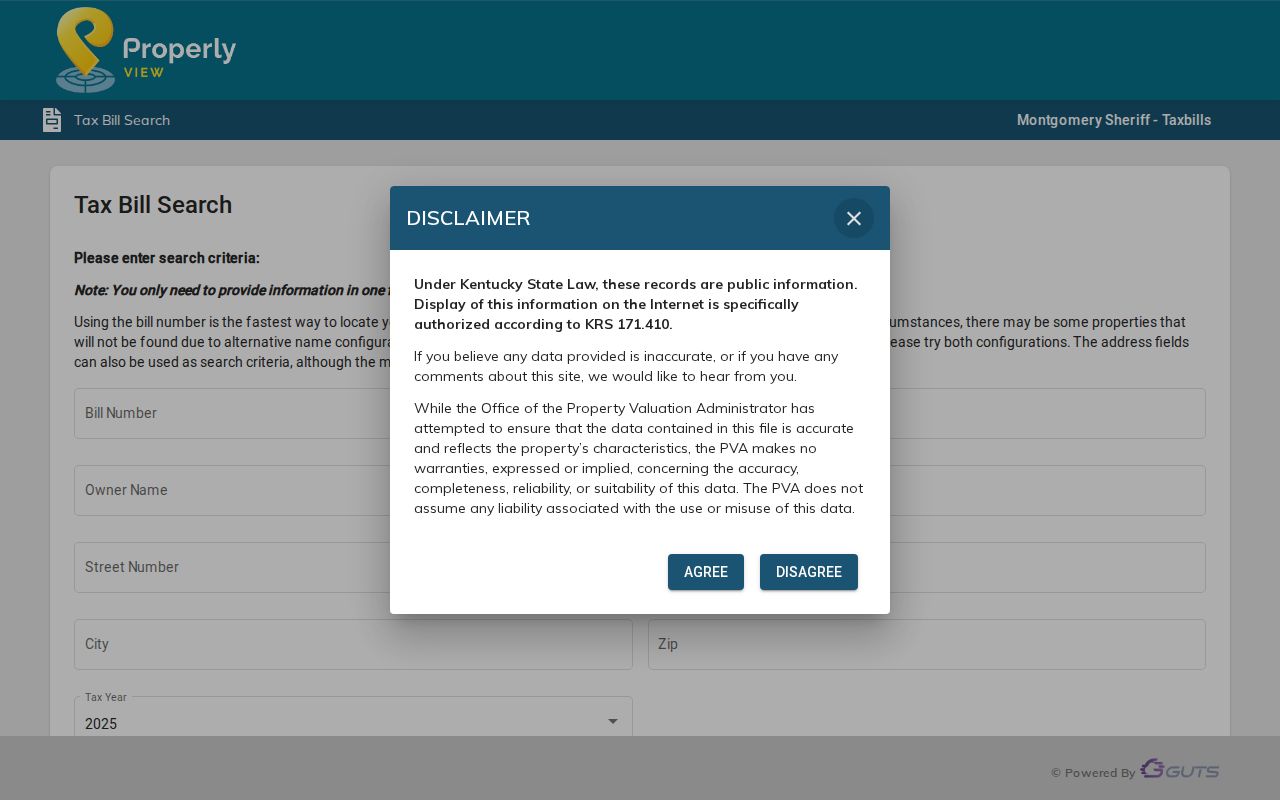
The destination still works. Its current local fields, year range, receipts, and payment terms need live confirmation.
Review a Montgomery Assessment
Assessment questions begin with the PVA, not the Sheriff. Compare acreage, class, improvements, exemptions, and the assessment year against the actual property. A deed, survey, photographs, correction records, or qualified comparable sales can address a factual or valuation issue. Ask the PVA for the current appeal path. Montgomery's deadline and board calendar are not published. Confirm both before relying on a filing window. The payment deadline and the assessment-review deadline are not the same, and a correction in one system does not automatically update the other.
Confirm the current window. Ask the Montgomery County PVA for present conference and appeal dates before filing.
For the meaning of assessed, market, and recorded sale figures, see the Montgomery property values page. Property tax records stay the source for bills, exemptions, collection, and delinquency.
The Kentucky Open Records Act backs up a request when a public tax record is beyond ordinary portal or counter reach. The Montgomery County Clerk's published policy allows a five-working-day determination period, weekends and legal holidays excluded. Send the request to the agency holding the record, name the parcel and tax year, and describe the roll entry, notice, bill, or payment record wanted. A response date alone is no promise that every item is open or produced instantly.
For in-person or phone help, the PVA sits at 44 West Main Street, Suite E, in Mount Sterling, at 859-498-8710, weekdays 8:00 to 4:00. The Sheriff collects county taxes, while the Clerk holds the post-transfer delinquency layer. Name the exact record type before a visit. That habit keeps an assessment question away from the bill collector and a payment question from being read as a value dispute.
The PVA's mailing-address change route shows that a notice address and a property location are separate things. A Mount Sterling mailing line can sit on land in Camargo or rural Montgomery County. Search the physical road and the parcel number. Save both fields rather than overwriting the situs with the taxpayer's mail destination.
The PVA may inspect property under KRS 132.450, and some property is centrally valued instead of locally assessed. Ask whether the subject is a local real parcel, a personal-property account, or a centrally valued class. That answer beats blaming a portal for detail it never carries. Keep the custodian's response with its retrieval date for the file.
Court and deed records can explain a tax entry without replacing it. A commissioner deed may follow foreclosure or partition. An executor deed may follow probate. A tax lien, or a later release, may surface in the Clerk's land index. When such an instrument appears, lay out a short timeline: court order date, deed recording date, assessment year, bill year, delinquency status. The dates often explain why one office names a different party. Never collapse them into one undated "owner" field.
For a saved bill, note which fields the source displays: amount due, amount paid, balance, receipt, payment date, district, taxpayer, situs, and parcel number. Montgomery's PVDNet screens show only what they show, so record the fields actually present on the result. Skip any field the current display omits, and keep payment credentials and other private data out of screenshots.