
Trace Montgomery County Former Owners by Era
Build a timeline first. Every transfer gets a row and its source. Montgomery County's historical holdings reach well beyond the present eCCLIX interface, though access shifts across eras and the recorder publishes no stated earliest year for the online material.
| Transfer Date | Grantor → Grantee | Deed Type | Book/Page |
|---|---|---|---|
| Newest recording | Latest seller → current grantee | Warranty, quitclaim, commissioner, or other | Current index reference |
| Prior recording | Earlier owner → newest seller | Read from prior-instrument reference | Repeated cited book/page |
| 1891–1961 | Cross-indexed parties | Conveyance in deed body | County books, KDLA, FamilySearch |
| 1797–1890 | General grantor/grantee entries | Early conveyance series | Historic index and deed books |
Treat this as a working chain format, not a claim about one parcel. Add a row only after its legal description matches the land already being traced.
Reconstruct Montgomery County’s Deed Chain Backward
The Montgomery County Clerk routes online deed work to eCCLIX. Private access is free but capped at five searches per day. Images sit behind an account. Plan each name search from the deed already in hand. For the official route and its access rules, view the Clerk's online-records page.
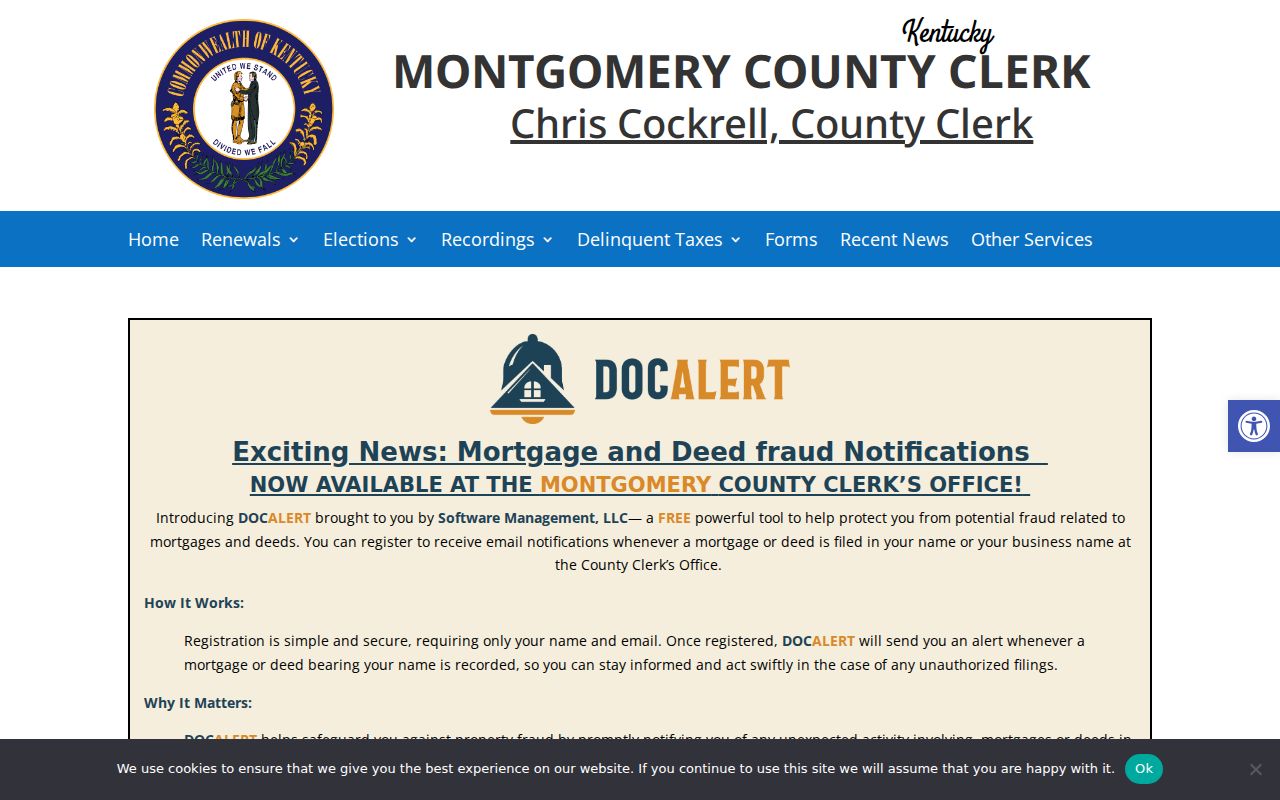
The image shows the county's official eCCLIX route and its access explanation. It does not establish the prior owners of any particular parcel.
- Find the current acquisition deed and verify the parcel by legal description.
- Read its grantor and any prior-instrument or book/page citation.
- Search that grantor as a grantee to find how the former owner acquired the tract.
- Repeat until web coverage ends, then continue in books, KDLA microfilm, or FamilySearch.
- Grantor
- The party conveying an interest.
- Grantee
- The party receiving that interest.
- Chain of title
- The ordered sequence of ownership transfers for the same land.
- Reverse index
- A grantee-oriented path to how a seller acquired the tract.
- Quitclaim and warranty deed
- Different conveyance forms whose effect cannot be judged from the label alone.
Go Back Through Montgomery’s H, C, and S Headings
Title did not always move by an ordinary sale. Montgomery County's historical index uses H, C, and S headings whenever heirs, commissioners, or sheriffs enter the deed records. Those entries can expose probate distribution, partition, foreclosure, or a tax-related conveyance. Search both sides of a name. Test spelling variants as well. An estate may sit under the decedent, the executor, the heirs, or a commissioner, so tie each deed to the probate or court file that authorized the transfer.
Track Montgomery Former Owners Through Lot Changes
A chain can look broken when a parent tract splits, parcels merge, or a modern street address replaces lot-and-block or metes-and-bounds text. Follow the acreage instead. Adjoining owners, plat name, lot number, and prior references keep the parcel on track better than today's address. The Clerk records plats. The county publishes no public parcel GIS viewer, so state GIS maps serve only as context for roads and places. A tax-map line is not a legal boundary.
Repair Montgomery Ownership Gaps From 1851 and 1863
KDLA records courthouse disasters in 1851 and 1863. Those fires explain why a Montgomery County deed chain may need bridge sources. They do not prove every missing item burned. First retest the correct index, spelling, book, and neighboring dates. Then turn to bridge sources. These include tax assessment books, wills, probate settlements, county order books, civil cases, later deed recitals, newspapers, and microfilm holdings. KDLA lists order books for 1853–1866, civil cases for 1848–1979, and wills for 1797–1931.
Online cutoff unknown. The exact earliest Montgomery eCCLIX year was not confirmed; older owners remain in deed books, KDLA, and FamilySearch.
Link Montgomery Prior Owners With Tax Books and the 1879 Map
KYGenWeb posts transcriptions of County Clerk tax assessments for 1797, 1799, 1800, 1801–1805, and 1806–1810. It also covers the 1810 census. Verify every lead against the original. A taxpayer or occupant is not always the owner of record. The Library of Congress 1879 cadastral map adds resident names and a business directory. It also supplies a population table and four insets. Treat a map name as a dated hypothesis. Then test it against deeds, tax rolls, probate, and newspapers before it enters the chain.
Reconnect Montgomery Estate and Guardian Transfers
A death can break a clean name sequence. Search wills, probate inventories, settlements, guardianship files, commissioner deeds, and later conveyances. The Circuit Clerk holds the actual court file when litigation or a judicial transfer occurred. CourtNet is only the index route. The Montgomery County History Museum keeps genealogy and family files, and local newspaper holdings can reveal a sale or an heir relationship. Context helps, but the deed or court order still carries the property transfer.
Measure How Far Back Montgomery Ownership Records Go
The county site says 1796; KDLA says 1797. Keep that difference visible. Holdings include the 1797–1890 general grantor and grantee index, 1891–1961 cross-indexes, deed series beginning in 1800, and wills from 1797. Ask the Clerk for courthouse copies. The Kentucky Department for Libraries and Archives handles inventories, microfilm, and remote requests, though FamilySearch images may require login or restricted access.
Use history with care. Prior-owner records support house history, estate work, and title research. Never use them to track, harass, threaten, or target a living person.
Keep a running log as the ownership chain grows. For each former owner, enter both indexed spellings and the role as grantor or grantee. Add the instrument type, execution and recording dates, and the book and page or instrument number. Include the acreage, legal description, prior reference, and where the copy came from. A tidy log separates a genuine gap from a missed spelling variant. It also keeps a person with the same surname out of the wrong tract.
Deed research does not stop with eCCLIX. The County Clerk at 1 Court Street, Suite 2, Mount Sterling, 859-498-8700, holds the courthouse books and can supply copies. The standardized open-records form may be delivered by hand, mail, fax, or email. KDLA will answer a specific remote request for a fee, and FamilySearch catalog images may require an account or affiliate access. Once the official record yields a date and a name, the history museum and library can help. Ask about newspapers, family files, roads, and local terms.
Handle dates with care. Execution can precede recording. An assessment reflects January 1. A probate or court order may authorize a sale before the commissioner deed is recorded. Place all four events on one timeline instead of treating any single date as controlling. That habit explains why a tax payer, the occupant named on the 1879 map, an estate representative, and a deed grantee can differ. Every source stays true all the same.
A negative result deserves precision too. Name the index searched, the date range, the spelling used, the access condition, and the missing item. "Not found online" does not mean "never recorded." Unresolved gaps and conflicting legal descriptions belong with the Clerk, an attorney, or a qualified title professional. Take them there before anyone relies on title.
Plats hold the chain together in another way. Note the subdivision, lot and block, survey references, easements, roads, and adjoining owners stated on the instrument. Hundreds of Montgomery plat records preserve a tract's identity even when the owner name or street has changed. A plat does not transfer title by itself, so link its lot to each deed.
When asking staff for a historic item, skip the request for "everything about the property." Give a former owner's full indexed name, an approximate transfer year, and a deed-book clue. Add the subdivision or tract and the exact copy or index entry needed. A focused request is easier to repeat and leaves a cleaner audit trail. County policy cites copy charges and advance postage, so confirm the current total with the Clerk before ordering.
Request historical newspapers by title, date, and event. The Columbian Spy, Mount Sterling Whig, Kentucky Sentinel, Sentinel Democrat, and Montgomery Times appear in identified catalogs or holdings. A sale notice, obituary, or legal advertisement can suggest heirs and dates. Each remains secondary to the deed, probate order, or court judgment. Those documents actually transferred the land.