
What Montgomery Deed Records Convey
The county clerk's Real Estate Recordings department is the official home of Montgomery County land records. Its holdings span deeds, mortgages, tax liens, and plats. These include thousands of real-estate documents. Hundreds of plat drawings sit there too. A deed records the transfer itself. Mortgages, releases, liens, easements, powers of attorney, leases, and affidavits may affect or explain the interest. Only the deed conveys it.
| Deed Type | What It Does | Common Use |
|---|---|---|
| Warranty deed | Conveys the stated interest with title promises | An ordinary sale |
| Quitclaim deed | Conveys only the interest the grantor may hold | Family or title cleanup |
| Executor deed | Conveys property through an estate representative | Probate administration |
| Commissioner deed | Records a court-authorized conveyance | Judicial sale or partition |
| Sheriff deed | Records a transfer through a sheriff process | Enforced or tax-related sale |
Instrument type matters when reading a deed. The consideration figure is not automatically market value. This is especially true in family, estate, nominal, or other non-arm's-length transfers. Read party capacity, execution and recording dates, consideration, the legal description, prior references, and signatures together as one document. Then widen the search to later mortgages, assignments, releases, tax liens, and court notices. Do this when the transfer alone is not enough.
Montgomery eCCLIX Access Rules
The Clerk's online-records page routes searches into the eCCLIX system. Montgomery County allows private users five free searches per day. The system is account-gated. Signing in is required to reach every image. Commercial accounts follow a separate county-selection and charging arrangement.
| Index item | What to capture | Why it matters |
|---|---|---|
| Party | Grantor, grantee, exact entity or estate style | Connects each transfer |
| Reference | Instrument number or book and page | Retrieves the filing |
| Date | Execution and recording dates | Orders the chain |
| Description | Lot, block, tract, plat, acreage | Confirms the land |
| Document type | Deed, mortgage, release, lien, plat | Separates transfer from burden |
Exact earliest online dates and category cutoffs are not exposed. Note the search date and the portal build when saving a result. The eCCLIX screen showed build 2026.07.2.1, useful context if fields later change.
Montgomery Deed Indexes Since 1797
Online access is only one layer of Montgomery County deed records. FamilySearch catalog entries and the Kentucky Department for Libraries and Archives inventory identify a general grantee and grantor index covering 1797 through 1890. They also list cross-indexes for 1891 through 1961. Deed volumes run from 1800 through 1866. Those ranges form a deep paper and film route into Montgomery County property records. The exact eCCLIX cutoff stays unconfirmed. Older deeds can be reached through courthouse books, KDLA microfilm, FamilySearch catalog material, or a request for a courthouse copy. KDLA's research room handles specific remote requests for a fee. A strong request gives the county, party names, an estimated year, the deed type, and any book-page reference already found. That works far better than asking for everything tied to a surname. Read the older index from both directions. A grantee index finds the deed by which a party received an interest. A grantor index finds the later instrument by which that party sold it. Cross-index entries through 1961 bridge name searches into deed books when no modern instrument number exists. Copy each spelling, initial, married name, estate style, and business form exactly as indexed. An early tax assessment may hint at possession or a taxable interest, but it is not a conveyance. Use the tax name only to shape the next deed, will, or court-book query. KDLA's Montgomery inventory adds companion series. Wills run from 1797 through 1931. County order books cover 1853 through 1866. Civil case material reaches from 1848 through 1979. Those files can explain a commissioner deed, estate sale, partition, or court-ordered transfer. They matter when the deed index shifts from an individual to heirs, an executor, a commissioner, or a sheriff.
Bridging Montgomery Courthouse Gaps
KDLA lists Montgomery courthouse disasters in 1851 and 1863. Those events explain why some early chains need more than a deed volume. They do not prove every missing entry burned. Test the index, adjoining volumes, later deed recitals, tax books, wills, county order books, civil files, newspapers, and duplicate or microfilm collections before calling a gap permanent.
Research beyond the break. Montgomery tax material, probate files, later recitals, and the 1879 cadastral map can supply leads, but only a deed or court conveyance transfers title.
The county site dates formation to 1796, while KDLA's disaster table uses 1797. Preserve that difference. Searchers should not force one date into every catalog query, since the earliest indexes and institutional histories may use different starting labels.
Plats Within Montgomery Deed Records
The clerk reports hundreds of plats among Montgomery County deed records. A deed may describe property by subdivision, lot, block, phase, survey, metes and bounds, or a reference to an earlier plat. Pull the named plat whenever a boundary, access, right-of-way, common area, or restriction question remains open. A tax-map outline helps locate the parcel. It cannot replace recorded plat language or a survey. Compare the deed and plat identifiers with care. Parcel IDs can change after a split, merger, or renumbering, while the legal description often preserves the link to the earlier tract. The Montgomery County parcel map route explains why a parcel polygon is a reference rather than boundary proof.
Following Montgomery Grantors and Grantees
A grantor conveys the interest. A grantee receives it. The chain of title is simply the ordered record of those transfers for one property, and a deed records search in Montgomery County usually starts at the newest reliable deed before stepping back one conveyance at a time. Because names repeat across decades, the legal description and prior-recording references are what keep your parcel search tied to the land itself.
- Find the newest deed and confirm the current party as grantee.
- Read its grantor, legal description, date, and prior reference.
- Search that grantor as a grantee in an earlier period.
- Repeat while matching the same tract, lot, or acreage.
- Move to books, film, probate, or court sources when the online run ends.
- Grantor
- The party transferring an interest.
- Grantee
- The party receiving it.
- Chain of title
- The ordered sequence of conveyances for the land.
- Book/page or instrument number
- The Clerk's reference used to retrieve the recorded document.
Obtain a Montgomery Deed Copy
An eCCLIX image works well for a quick look. Use it when the filing you want is posted there. Permanent copies stay with the Montgomery County Clerk, though. The vendor points users back to the original county filing whenever legal reliance matters. You can order at the counter, by phone, by email, or in writing. Give the office the party names, document type, date range, and instrument or book-page number. The Clerk sits at 1 Court Street, Suite 2, Mount Sterling. The main number is 859-498-8700.
A Kentucky Open Records Act request is another route if an ordinary copy inquiry stalls. The Clerk publishes a standardized request form and policy. That policy allows five working days for a determination. Weekends and legal holidays are excluded. It also sets a noncommercial copy rate of $0.50 per copy before statutory fees and advance postage. Ask about the current charge before ordering.
Recorded, not guaranteed. The Montgomery deed index reports filed instruments, not every possible unrecorded claim, and it is not a legal title opinion.
If an executor, commissioner, or sheriff deed turns up, pull the linked probate or court file too. Those papers can show the authority, order, sale report, or confirmation behind the conveyance. For prior ownership rather than a single instrument, work through Montgomery County's former-owner chain.
Keep any mail or records-act request narrow. One record set, one tight date span. Include the grantor, grantee, deed type, approximate filing date, legal description, and any reference you already hold. Ask whether the office can send an ordinary image or a certified copy. The policy adds $5 per noncommercial recording, computer disc, or tape on top of the paper rate. But statutory recording fees govern. Confirm the amount and delivery method before you pay.
Search related instruments under both parties as well. A mortgage names the borrower, lender, principal, legal description, and recording reference. An assignment changes the holder; a release or satisfaction records the discharge. Tax liens, easements, restrictive covenants, leases, powers of attorney, affidavits, and lis pendens can all attach to the same tract. A lien entry alone does not mean the debt is still open. Chase down any later release, judgment, settlement, or other disposition and note its date.
Montgomery Deed Alert Monitoring
Doc Alert, described on the Clerk's online-records page, is a free fraud-notification service. You register a name and email. The service then sends an alert whenever a deed or mortgage is filed under that person's or business's name. It flags new filings for prompt review.
Name-based monitoring is not a parcel-based title guarantee, however. A spelling variation may call for separate searches. A different entity style or an unusual instrument may too. Anything outside the stated deed and mortgage triggers deserves a second look. Check each alert against the Clerk's index. Call the office if a filing looks unfamiliar. The official layout appears on the County Clerk online-records page.
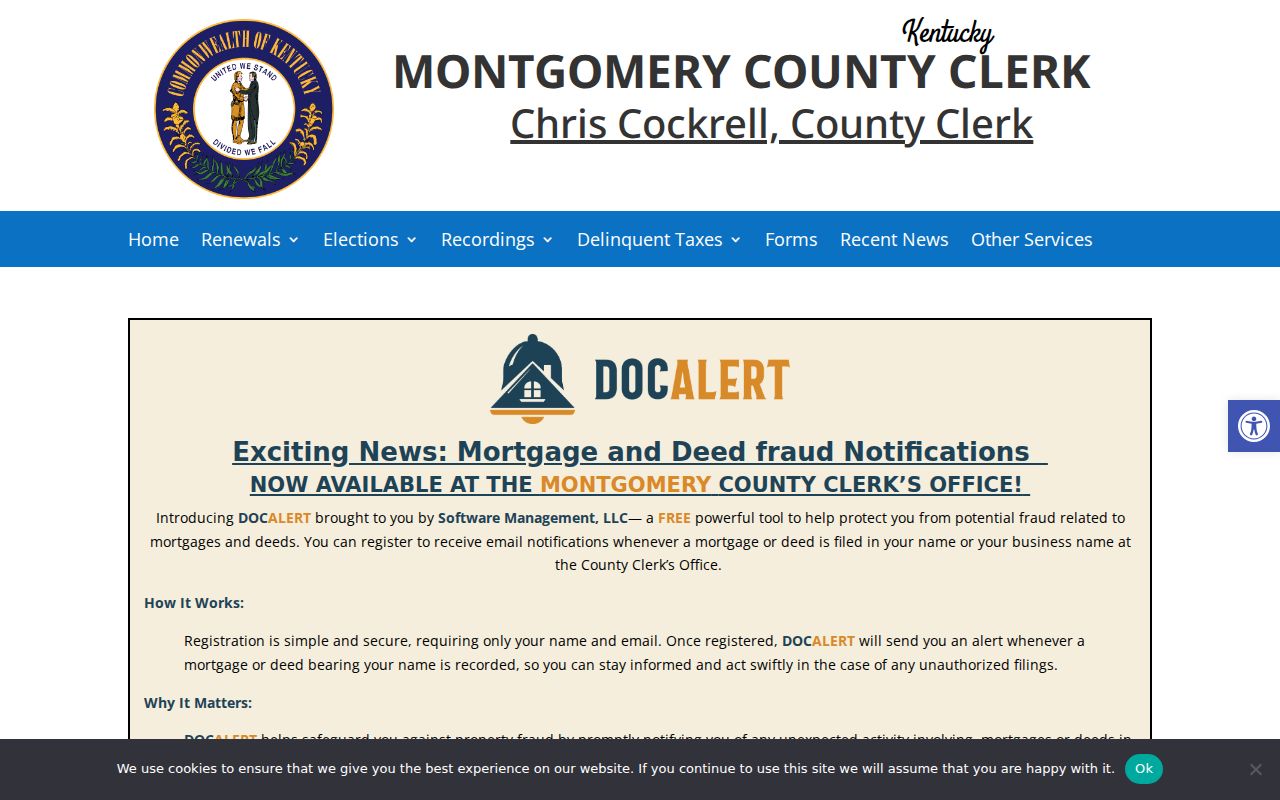
Note: The Clerk's online-records page shows the county route to follow before you begin an account-gated eCCLIX deed records search.